
AMTN Analytics provides a broad market perspective through the lens of intermarket analysis, relative strength, and momentum.
AMTN Analytics views price as a reflection of economic outlooks and corporate profit expectations translating into investor psychology converging into market trends. Identifying central tendencies within market structures establish discernable directional biases, which are then overlayed with quantitative data and qualitative insights to form a comprehensive global investment thesis that funnels down to a Canadian market focus.
Intermarket Analysis
Developing sound market assessments requires a broad perspective rooted in the relationships between asset classes. Since currencies, commodities, and bonds are deeply interdependent, analyzing equities in isolation creates a strategic blind spot.
Relative Strength
Relative strength analysis sharpens the top-down investment process by optimizing sector rotation strategies. Its primary goal is to identify the sectors driving market performance and, crucially, the specific constituents within them that are exhibiting market leadership.
Price Momentum
Gauging the velocity of price changes, momentum analysis assesses developing and overextended trends. By supplementing traditional price analysis, it provides an additional vantage point that supports market assessments and investment process.
The sandbox is the S&P/TSX Composite Index—the headlining barometer for the Canadian equities market.
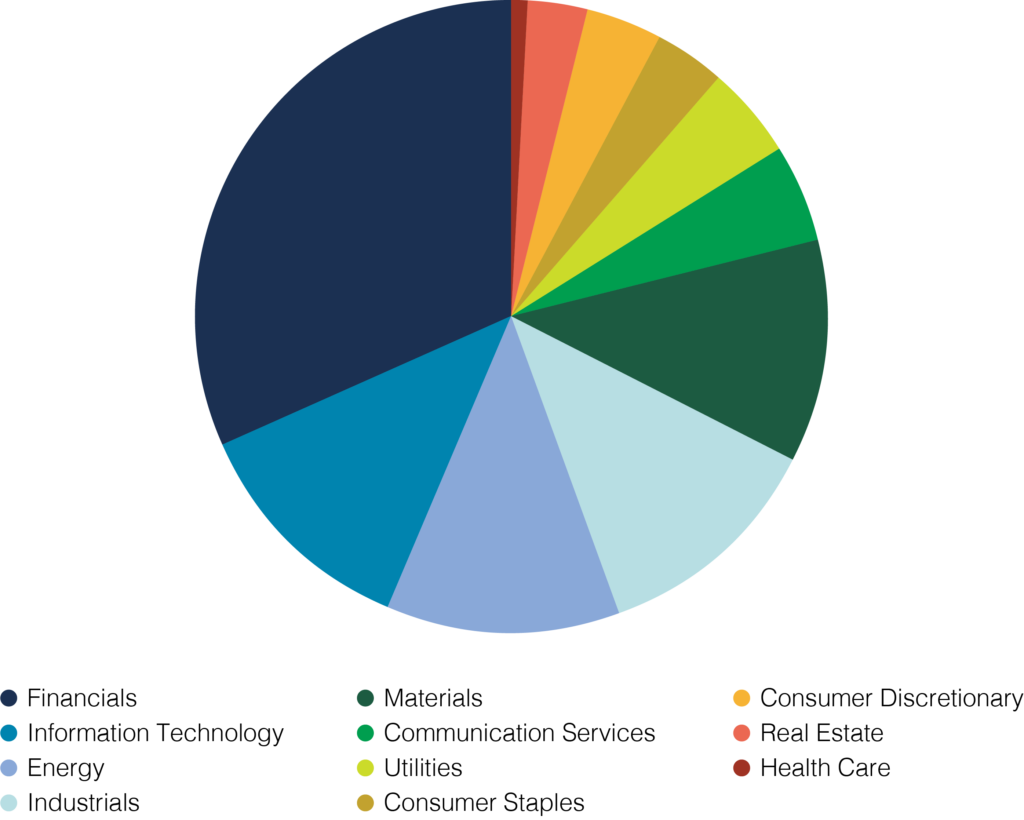
The S&P/TSX Composite Index is a float-adjusted market capitalization-weighted index of 229 constituents, with an estimated total market capitalization of $3,251,150 (CAD Mil). Historically, the index is heavily concentrated in the Financials, Materials, and Energy sectors, making it a sector-concentrated proxy—unlike the broader S&P 500 in the United States. Although the focus is on observing trends in the Canadian equities market, which accounts for less than 5% of global financial markets, Canadian investors should remain cognizant of this concentration risk to appropriately assess and manage their portfolio risk.
S&P/TSX Composite Index as of August 31, 2021, S&P Dow Jones Indices
While luck—both good and bad—plays a role in investment outcomes, long-term success is a product of consistent, high-quality decision-making compounded over time.
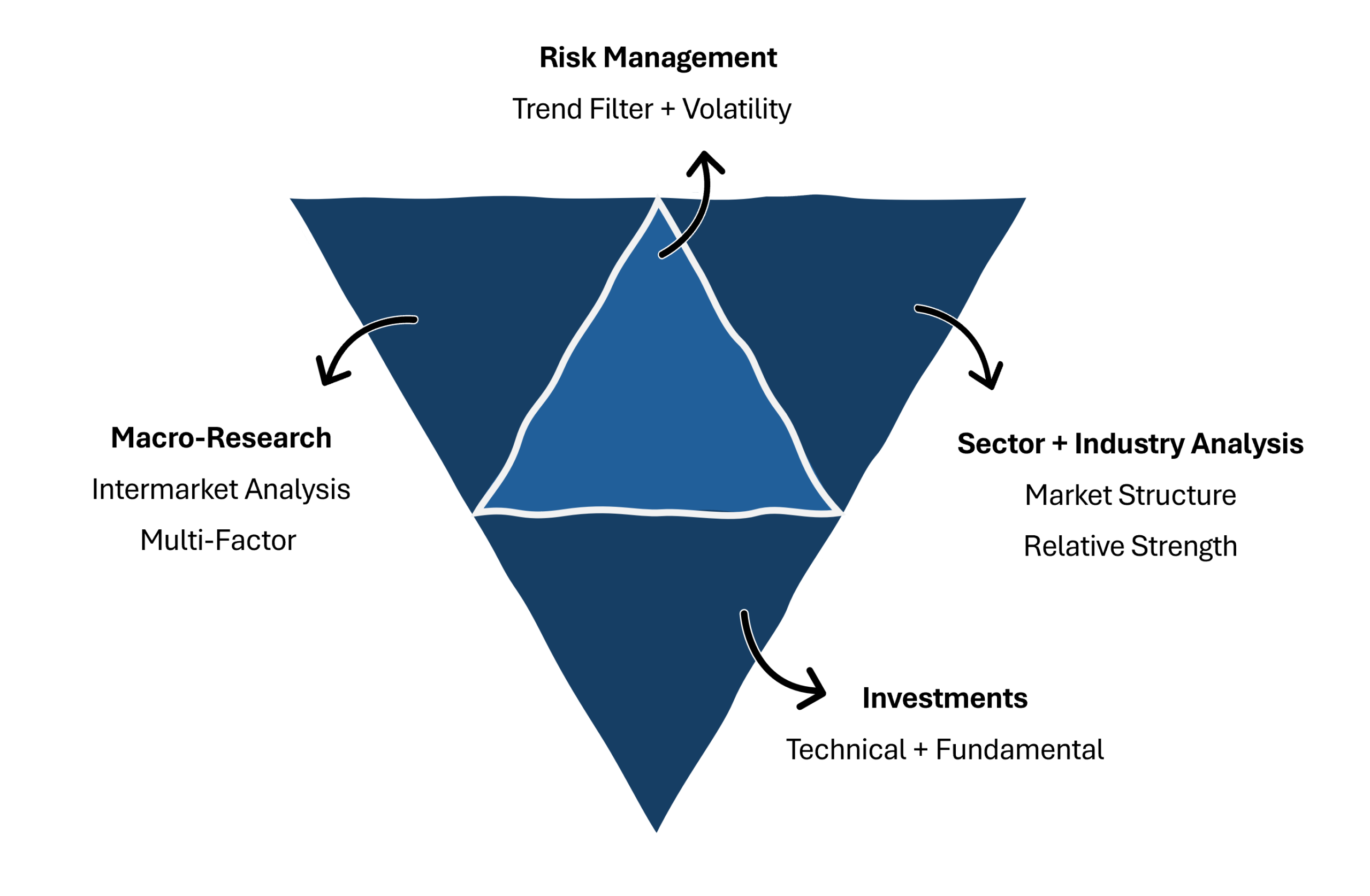
Financial markets are navigated through a top-down framework anchored in discipline and active risk management. Utilizing a “weight-of-the-evidence” approach, this process synthesizes intermarket relationships, sentiment, and breadth to establish an informed risk-on or risk-off posture. Analysis then isolates sector leadership at the intersection of relative strength, momentum, and market structure—targeting high-probability industry groups with favorable risk/return profiles. This process is further refined by integrating quantitative data with qualitative insights, ensuring research remains grounded as financial markets reflect business cycle shifts.
Charting markets, observing trends, & painting a broad stroke of color.
- Localized Stress Signals Fractures in Lower-Tier SpreadsThe U.S. Dollar Index, currently trading at $99.25, reflects a period of depreciation against its major trading partners. After a sharp 13% slide in the first half of 2025, the index entered an accumulation phase to establish a floor. Year-to-date gains remain a marginal 0.45%, stifled by persistent macroeconomic headwinds.… Read more: Localized Stress Signals Fractures in Lower-Tier Spreads
- Rising gold prices: a win for miners, a boost for the TSX Materials sector.By comparison, the US Dollar fell 9.78%, while the Thomson Reuters/Core Commodity Index edged up 0.44%—stifled by a decline in oil prices. Conversely, global equities (MSCI ACWI) surged 19.14%, and US Government Bonds (iShares 7-10 Year Treasury) gained 4.60%. Gold shined brightly in 2025, hitting all-time highs. Gold demand stems… Read more: Rising gold prices: a win for miners, a boost for the TSX Materials sector.
- The harmony of doubt: are Canada’s technical and fundamental indicators in tune?International equities significantly outperformed U.S. equities in 2025, led by strong results in Brazil, China, Canada, Germany, and the UK. U.S. underperformance was driven by a weaker U.S. Dollar, differing central bank policies maintaining “higher for longer” rates, and a rotational shift away from the highly valued U.S. growth-oriented market.… Read more: The harmony of doubt: are Canada’s technical and fundamental indicators in tune?